

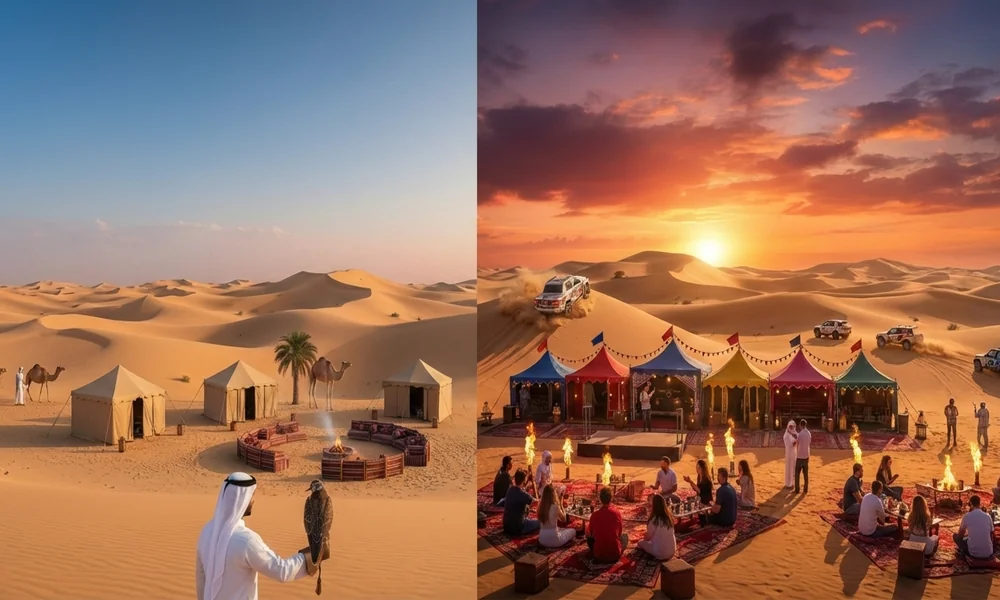
An Evening Desert Safari is often described as a collection of activities.
Dune bashing. Sunset photography. Camel riding. Dinner. Entertainment.
But that description misses the most interesting part.
The real character of an evening desert journey comes from transformation.
You enter the desert while the sun is still strong. The dunes appear bright and sharply defined. As the afternoon progresses, shadows lengthen and the landscape becomes warmer. Then sunset arrives, the sand deepens into orange and copper tones, and finally the desert shifts again into the cooler colors of twilight.
In only a few hours, travelers experience several versions of the same landscape.
That is what makes an Evening Desert Safari different from a simple desert activity.
It is not only about what you do.
It is about watching the desert change while you are inside it.
The Evening Desert Has a Natural Storyline
Morning desert experiences often feel direct and adventure-focused.
Evening safaris develop more gradually.
The journey usually begins while the desert is still bright. There is movement, off-road driving, and activity.
Then the pace changes.
The light becomes softer.
Photography becomes more important.
Vehicles stop on elevated dunes.
Travelers begin looking toward the horizon rather than the next activity.
After sunset, the experience changes again as the group transitions toward the camp or final stage of the tour.
This gives an Evening Desert Safari something many short excursions do not have:
A natural beginning, middle, and end.
Why Late Afternoon Light Changes the Dunes
Desert landscapes are heavily influenced by light.
During the middle of the day, sunlight falls more directly onto the sand. This can reduce visible contrast across dune surfaces.
As the sun moves lower, everything changes.
Dune crests become brighter.
Opposite slopes fall into shadow.
Wind patterns become easier to see.
Small ridges suddenly appear more dramatic.
The landscape gains depth.
This is one reason evening desert photography often looks more impressive than images taken under harsh midday sun.
It is not simply because sunset produces better colors.
It is because low-angle light reveals the structure of the desert.
An Evening Desert Safari Begins Before Sunset
One of the biggest misconceptions is that evening safaris are mainly about watching the sun disappear.
The experience usually begins much earlier.
That matters because the best desert journeys use the hours before sunset intelligently.
This period can include:
- Off-road dune driving
- Scenic desert routes
- Sandboarding
- Quad biking
- Photography stops
- Camel riding
- Elevated dune viewpoints
The goal is to reach the strongest visual part of the desert at the right time rather than simply arriving for sunset.
A well-planned Evening Desert Safari therefore depends heavily on timing.
Too early, and travelers spend too long waiting.
Too late, and the best light is missed.
The Desert Becomes More Dramatic as Shadows Grow
Dune landscapes need shadows.
Without them, the terrain can appear almost flat in photographs.
As evening approaches, shadows stretch across the desert and create stronger separation between dune formations.
This makes the landscape appear larger.
A single dune ridge can cast a long shadow into the valley below.
Tracks become more visible.
Footprints create patterns.
Vehicles stand out against illuminated slopes.
For travelers interested in photography, this is one of the strongest reasons to choose an evening experience.
The scenery continuously improves as the light becomes lower.
The Best Sunset Stop Is Not Always the Highest Dune
Travelers often assume the highest dune automatically offers the best sunset view.
Not necessarily.
A good viewpoint depends on several factors:
- Clear western visibility
- Interesting foreground dunes
- Minimal vehicle congestion
- Enough space for photography
- Safe access
- Appropriate timing
Sometimes a slightly lower ridge produces a better photograph because layered dunes appear between the camera and the horizon.
The strongest desert photography often uses depth rather than height.
An experienced Desert tour Capture Desert style itinerary should therefore treat the sunset stop as part of the route design, not as an accidental pause.
Sunset Is Only Half the Visual Experience
Many visitors put their cameras away immediately after the sun disappears.
That can be a mistake.
The period after sunset — often called blue hour — creates a completely different atmosphere.
The sky becomes softer.
Warm colors gradually disappear from the sand.
Vehicle lights become more noticeable.
The landscape begins losing detail and turning into silhouettes.
This transition can be one of the most atmospheric stages of an Evening Desert Safari.
For photographers and content creators, the final minutes of natural light often produce images that look completely different from standard desert photography.
Dune Bashing Feels Different Late in the Day
Dune bashing is commonly discussed as a pure adrenaline activity.
But late-afternoon driving has another dimension.
As sunlight moves lower, the driver and passengers experience changing visibility across the terrain.
Dune edges appear more defined.
Long shadows emphasize slopes.
The vehicle moves between bright ridges and darker dune valleys.
This creates a more cinematic driving experience.
Rather than seeing one continuous beige landscape, passengers experience repeated changes in light and elevation.
That is part of what makes evening dune driving visually memorable.
The Route Matters More Than the Activity List
Two safari packages can contain exactly the same activities and still provide very different experiences.
The difference often comes from route planning.
A strong evening route should gradually build toward sunset.
Adventure activities can happen earlier.
The most scenic dune formations should ideally appear closer to golden hour.
Photography stops should be timed rather than random.
The camp transition should happen after the strongest natural light.
This creates flow.
Without that structure, an evening safari can feel like several disconnected activities.
With good timing, the entire journey feels intentional.
Why Evening Desert Tours Suit Travelers Who Want Variety
Some travelers want pure adventure.
Others want photography.
Some want cultural activities.
Others want a relaxed evening away from the city.
An Evening Desert Safari works well because it can combine these different expectations in one experience.
Adventure comes first.
Scenery becomes more important later.
Then the atmosphere slows down.
For mixed groups — couples, families, friends, or first-time Dubai visitors — this variety can be especially useful.
Not everyone needs to enjoy the same part of the safari most.
Quad Biking Adds an Active Layer Before Sunset
A Desert safari with quad bike can work particularly well in the late afternoon.
Quad biking gives travelers direct control over their movement through the sand.
Instead of remaining a passenger throughout the tour, the rider becomes actively involved.
This creates an interesting contrast with the rest of the evening.
The quad bike section is energetic and physical.
The sunset section is slower and visual.
The camp experience is relaxed and social.
When arranged properly, these changes in pace prevent the evening from feeling repetitive.
Why Sandboarding Works Better as a Short Activity
Sandboarding is often most enjoyable when treated as a focused activity rather than a long session.
A suitable dune is chosen.
Visitors climb the slope.
They descend.
Photos and short videos are captured.
Then the journey continues.
During an evening safari, this works especially well because travelers can experience the activity without sacrificing the narrow window of golden-hour light.
A good itinerary protects the sunset period rather than filling every minute with activities.
The Transition From Vehicle to Camp Matters
The journey from the dunes to the desert camp can influence how the evening feels.
If handled poorly, it can feel like the adventure suddenly ends.
If handled well, it feels like a natural shift.
During this part of the journey, the sky is usually becoming darker.
The temperature changes.
The visual intensity of the dunes decreases.
Camp lights begin appearing in the distance.
This creates a psychological transition from exploration to relaxation.
The strongest evening tours understand that pacing matters even between major activities.
Camp Experiences Should Complement the Desert, Not Replace It
A desert camp can add atmosphere, food, entertainment, and cultural elements.
But the camp should not become the entire identity of the safari.
The landscape is still the reason the experience exists.
A balanced evening desert tour uses the camp as the final chapter rather than the whole story.
Depending on the package, camp activities may include:
- Traditional seating areas
- Dinner
- Tea or refreshments
- Henna
- Short camel experiences
- Entertainment
- Photography
- Cultural displays
The exact inclusions vary.
What matters is that the camp adds to the desert journey rather than distracting from it.
Evening Safaris Create Better Contrast With the City
Dubai becomes visually striking after dark.
That makes returning from the desert particularly interesting.
For several hours, travelers have been surrounded by open sand, low horizons, and relatively little artificial light.
Then the city begins appearing again.
Road lighting increases.
Buildings return.
The skyline emerges.
This contrast can make the entire experience feel more dramatic.
An Evening Desert Safari therefore works not only because the desert looks beautiful at sunset.
It works because travelers leave one visual world and return to another.
Why Couples Often Prefer Evening Desert Experiences
The slower final stages of an evening safari can make it particularly appealing to couples.
Adventure activities provide energy earlier in the experience.
Sunset creates natural photography opportunities.
Later, the atmosphere becomes calmer.
This mix can feel more balanced than a purely action-focused morning tour.
Private or smaller-group options can make the experience even more flexible, especially for couples who want more time for photography or quieter stops.
Families Can Benefit From the Changing Pace
Evening safaris can also work well for families because the activity level changes throughout the tour.
Children and adults can enjoy the excitement of the dunes first.
Photography and camel riding provide slower moments.
The camp then creates an opportunity to sit, eat, and relax.
This variation can be easier than maintaining constant high-intensity activities for several hours.
However, families should always check age restrictions and suitability for dune bashing, quad biking, and other adventure activities.
Why the Red Desert Works Especially Well in the Evening
Dubai’s red dune areas become particularly striking as daylight fades.
The iron-rich coloration of the sand can appear deeper during lower-angle sunlight.
Orange tones become stronger.
Shadows may take on darker brown or purple tones.
The contrast between illuminated and shaded slopes becomes more noticeable.
For an Evening Desert Safari, this can create an especially photogenic environment.
The same location that appears bright and simple earlier in the day can become visually complex near sunset.
The Best Evening Safari Is Not the One With the Most Activities
Long activity lists look impressive in advertisements.
But they can create rushed experiences.
If every possible activity is included in a limited timeframe, travelers may spend the evening moving constantly from one station to another.
That can reduce the quality of the moments that matter most.
A stronger safari focuses on sequence.
Good dune driving.
Enough time for selected activities.
A properly timed sunset stop.
A comfortable transition to camp.
A relaxed final stage.
Quality often comes from pacing rather than quantity.
Evening Desert Safari vs Morning Safari
Morning and evening experiences serve different purposes.
A morning safari usually works well for travelers focused on adventure and efficiency.
An evening safari is more layered.
It moves from adventure into scenery and then into atmosphere.
Travelers choosing between them should think less about which is “better” and more about what they want from the desert.
Choose morning if you want:
- A shorter schedule
- Earlier adventure
- More of the day available afterward
- A stronger activity focus
Choose an Evening Desert Safari if you want:
- Changing desert light
- Sunset photography
- A longer progression
- Camp experiences
- A more atmospheric finish
Why Timing Can Matter More Than Weather
Weather is important, but timing inside the safari is equally important.
Even on a clear day, poor scheduling can lead to missed sunset opportunities.
An operator that understands local travel time, desert routes, activity duration, and sunset timing can create a much smoother experience.
This is particularly important because sunset cannot be delayed.
If a quad bike session takes too long or a group leaves the city late, the strongest light may disappear before reaching the planned viewpoint.
That is why experienced planning matters.
Choosing an Evening Desert Tour More Carefully
Before booking, look beyond promotional phrases.
Useful questions include:
- How much time is actually spent in the desert?
- When does the dune-driving portion begin?
- Is there a dedicated sunset stop?
- Is quad biking included or optional?
- Is the safari private or shared?
- Which desert region is used?
- How much time is spent at the camp?
- Are pickup and drop-off included?
- What activities are included in the advertised price?
These details give a much clearer picture of the experience.
Why a Desert Tour With Capture Desert Should Feel Curated
A strong Desert tour Capture Desert experience should not feel like a checklist.
It should feel curated.
That means the desert route, activity sequence, photography stops, and timing should work together.
Travelers should not feel rushed from one attraction to another.
The desert itself should remain central.
This is especially important for evening experiences because the natural light creates a limited window that cannot be recreated later.
When the schedule is designed around the landscape rather than around maximum activity count, the result feels more premium and memorable.
The Best Moment May Happen Between Activities
One of the most interesting things about an evening desert tour is that the strongest memory may not come from the headline activities.
It might be:
A silent minute on a dune after the engine stops.
The first moment the sun touches the horizon.
The shadow of a camel crossing illuminated sand.
The sound of the wind after a group moves away.
The first stars appearing above the camp.
These moments are difficult to advertise because they are not formal “activities.”
But they are often what travelers remember most.
Evening Desert Safari Is Ultimately About Transformation
The desert you enter is not the desert you leave.
At the beginning, it is bright, warm, and energetic.
Then it becomes golden.
Then copper.
Then blue-gray.
Finally, darkness reduces the landscape to silhouettes and open sky.
That progression gives an Evening Desert Safari emotional depth.
You are not simply visiting a location.
You are watching it transform.
Final Thoughts
The strongest Evening Desert Safari experiences are built around timing rather than excess.
The adventure should begin while there is still enough daylight to explore the dunes.
The route should become more scenic as the sun drops.
Photography should happen when the landscape is at its most dramatic.
Sunset should not feel rushed.
And the transition into the camp should feel like the final chapter of the journey rather than an unrelated activity.
For travelers looking for a Desert tour by Capture Desert experience that combines adventure, landscape, photography, and atmosphere, the evening offers something uniquely layered.
You begin with motion.
You reach the desert at its most colorful.
And you leave after watching the entire landscape change around you.
That is what makes an Evening Desert Safari more than just another item on a Dubai itinerary.
